Showing posts with label animals. Show all posts

Saturday, June 4, 2016

Krugers in the Kruger

One of the biggest nature reserves in South Africa (and undoubtedly the most well known) is the massive Kruger National Park in the Northeastern corner of Limpopo and Mpumalanga. Home to an incredibly diverse range of species including the Big Five, the Kruger has come a long way since it was originally established as the Sabie River Game Reserve in 1898 by the then-president of the Transvaal Republic, Paul Kruger (the name was later changed when a few smaller nature reserves merged together to form the Kruger).

The Paul Kruger Gate - in honor of his original vision for a nature/game reserve in the 'bosveld' (bush). 

The Park is now a world-famous attraction, and so we couldn't say we toured South Africa but didn't go to the Kruger (surnames aside). Thus followed a day of game watching (though it should be called first game-searching, then game-watching). Considering we started out rather late, we saw a huge variety of animals. 

Of the Big Five we saw 4 - number one was a whole herd of elephants. These giants are quite destructive, but the calves stay adorable. 

Sibling rivalry is not just among humans. 

Concerning antelopes, we saw many Impalas and a few Kudu, Waterbuck, Bushbuck, Steenbok, Nyala, and Blue Wildebeest. Interestingly enough, the Kruger does not have Gemsbok or Springbok, both which we saw plenty of in the Kgalagadi Transfrontier Park.

"What a beauuutiful day," says the Waterbuck calf (I adore this picture). 

Little Steenbokkie.

Some cool Kudu calf moves (evening stretches).

Beautiful shy Nyalas. 

This hyena was lying right next to the road. We suspect she was either pregnant, or had just eaten an entire impala by herself.  

We saw a couple of warthogs (Pumba!)... 

Tanning hippos...

The odd giraffe... 

Saturday, May 21, 2016

Kgalagadi and the Kalahari

After our Orange River trip in April, we were heading to the Northernmost part of the Northern Cape via Namibia. The road was long and straight, with towns marked on the map being little more than 10 houses and a few goats in reality. Namibia is not known for its many people.


We reached Askham and to our relief, there was a gas station. I took a picture because we are probably never going there again. 

We stayed at Kgalagadi Lodge that night and drove through a tiny part of the Kgalagadi Transfrontier Park the next day, a massive nature reserve in the Kalahari Desert region of Botswana, South Africa and Namibia. The Kalahari is a dry, sandy savanna area of southern Africa, semi-desert famous for its beautiful red dunes and 'wit grassies' (white grass), and it covers about 70% of Botswana, as well as parts of Namibia and South Africa. It was the first time we've been to the Kalahari, and our timing was perfect - recent rains had transformed the dry area into its most stunning state. 


 Maarten bought a Bushman bow-and-arrow (two arrows, to be exact), and thus he was running around hunting imaginary lions that evening. 

Drifting Shongololo (the word shongololo is Xhosa for millipede). There are a lot of these creatures in the Kalahari - their tracks cover the dunes in the morning. 

The said tracks. It looks like a miniature 4x4 car dared the dunes. 

We arrived late evening and dad, me and the boys went for a swim while mom stayed behind at the campsite. As pitching our tents would have been tricky (it's hard to get tent pens into pavement), mom suggested we sleep open, but upon our return she had definitely changed her mind. It seemed there was a tame emu stalking the campsite, and when mom had tried to take a nap, this guy walked right up to her and stared. After much laughter, we pitched the tents (though flimsily), and I figured The Emu has earned himself a portrait.

Guess who's coming to dinner...

Upon entering Kgalagadi Park, there were plenty of lazy Gemsbok and Springbok but less of everything else. We were hoping to see lions, but got lucky and saw a sleeping leopard instead. Unfortunately I couldn't take a picture - she was beautiful though. 

 Red hartebeest and Gemsbok. 

Springbok lambs - adorable. 

We also saw baby Gemsbok - his horns look like thorns. 

All the animals were lazy and fat, presumably because of the abundant grazing. 

Birds there were many, including the 'Gompou' (bustard), the heaviest flying bird on earth. 

I love the ostrich on the right, staring at her reflection: "I'm so gorgeous!" 

We saw a few falcons and eagles too. 

The sighting of the day, however, was two beautiful 'bakoorjakkalsies' (Bat-eared foxes). These giant-eared, tiny foxes are nocturnal and rarely come out in daylight. 

We also met clients of my mom who had invited us to visit if we ever came to this area, and stayed on with 2 families for 2 nights each where we experienced the famed 'boere' generosity of the Northern Cape. On the first farm, we had a fantastic time with 'oom' Jacques and 'tannie' Rika in the Kalahari. On arrival we were almost immediately taken 'springhaas' hunting/chasing at night by oom Jacques. This crazy activity involves chasing 'springhase' (nocturnal, weird, miniature kangaroo-like rodents) with a 'bakkie' (pickup) at night, and needs someone to hold a spotlight on the victim until it tires, half blinded by the light. Then someone else who can (preferably) run very fast over bushes and sand dunes chase after the springhaas and tries to catch it to the great amusement of the driver and other people on the back of the bakkie. 

Only dad managed to catch one, after a terrific dive into the sand. The boys were very impressed. 

The next day we were shown around the salt factory. In the Kalahari, there are natural, big salt pans (soutpanne) where extremely salty underground lakes prevent anything from growing on top. 


To reach the lakes, big canals are dug. The water in these canals are more than 90% salt (the Dead Sea is 48%). Apparently you can sit upright in the water and it only comes up to your waist. You can't stay in for very long though...


In order to then harvest the salt, the water must be pumped into shallow areas and allowed to evaporate.This is done in acres, where saltwater is pumped and evaporated layer after layer for 2 years. On top of this layer of salt more water is pumped, and only then salt can be scraped off and harvested. 

Sunday, October 18, 2015

From Kitten to Cat to Kittens!

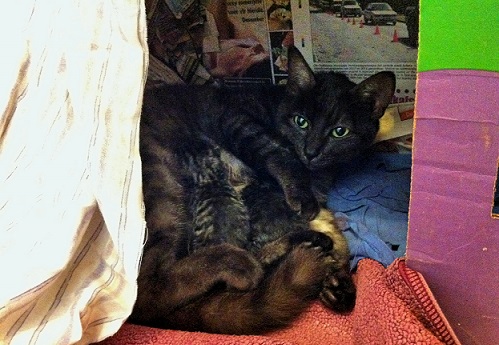
Over the past year we had our first ever cat in the house (which has always been my dream)! Our dear little kitten Nassie is however not so little anymore - we've had a wonderful time so far being cat owners (or perhaps cat-owned is more accurate?), and once again observed how all animals have their own personality. We enjoy Nassie tremendously, even mom and dad (who has never even had a cat when they were children)! Her dainty manners, stately cleanliness and clear attitude of absolute royalty makes us all smile. For no reason we can see, she strictly prefers to sleep on Theuns' bed during the day, and likes her morning pet at 8:00am precisely, thank you. She knows exactly what she wants and what she doesn't want - and woe to the one who dares to cross her on a bad day.

So here's a few photos of the past year...

Tiny and adopted, last December. 

She went from baby kitten to playful kitten to know-it-all-but-not-really teenager with hormones...


 .....and now Nassie is a mother!

From 'Kammanassie' to 'Mammanassie'...

She delivered two kittens in the bathroom, and was purring most proudly for the next 2 hours.


 One day old. 

"A dog will flatter you but you have to flatter the cat." ~ George Mikes

Monday, October 12, 2015

Animals Farewell - Horses' New Home and Piglets Gone

Earlier in September, our 2 ponies Arend and Valk found a new home... Because we are only staying on the farm until the end of the year, we knew from the start we would have to sell them again. They taught us many lessons, and we have been blessed by the opportunity to have had horses and getting some valuable experience and life lessons.
What triggered the sale so soon though, was the planting of new orchards. Their camp (and grazing/food) next to our house is now a young fig orchard.

The new owners live on a farm in the Baviaans, and we are sure they will take good care of the ponies - so after having come to visit and see Arend and Valk once, the next step was to figure out the transporting business. 


After weighing Arend on the cattle scale, we determined that the 2 ponies together on a trailer would still be under the weight limit. Thus, the trailer it was! 


First, they tried coaxing Arend on, thinking that if they could get him on Valk would quickly follow. Unfortunately they had underestimated Arend's stubbornness. 

Tempting with treats...

He refused to budge. 

Sunday, September 27, 2015

Auction Time

A while ago, there was some commotion down the road and when we went to investigate, cattle were being loaded onto a transport truck. 'Oom' Jan was taking sheep and cattle to a nearby auction the next day, and we decided to go check it out. We've been to auctions before, but all auctions are different and we figured it would be a fun outing. 

Loading the first bunch. 

Monkey tactics. 

The second bunch. 

Done!

 Sheep business.

It was a cattle and sheep auction (there are different auctions for different animals), and before they started, we walked around and checked out the process of how the animals got into the pens. First, the entire transporting vehicle including animals are weighed, and then the animals are unloaded and put into their pens. The vehicle is weighed again (minus the animals) so the total weight of the animals can be determined. 

Que for the (giant) scale. 

Empty pens awaiting occupants. 

A (literal) leap of faith for the sheep. 

Some brave ones who weren't supposed to jump. 

Chased to their pens. 

Groups of animals are sold by average weight (dividing the weight of the group by the number of animals). If an owner is selling animals in different groups but all of them were brought to the auction on one vehicle, once one group is unloaded the rest of the animals still on the vehicle has to be weighed again.


Before the auction started, we took a look at some of the livestock already in pens. From tiny calves (sold with their mothers, of course) to huge bulls, rams, ewes and lambs of different breeds of sheep; all awaiting their fate. 

Photographer and assistant (in the making). 

Soft and fuzzy...